guide
How to Play Mahjong Solitaire: Free Tiles, Layer Order and Dead Boards
Learn the free-tile rule, how to pick pairs that expose the most tiles, when flowers and seasons match, and how to avoid dead-ending a 144-tile layout.
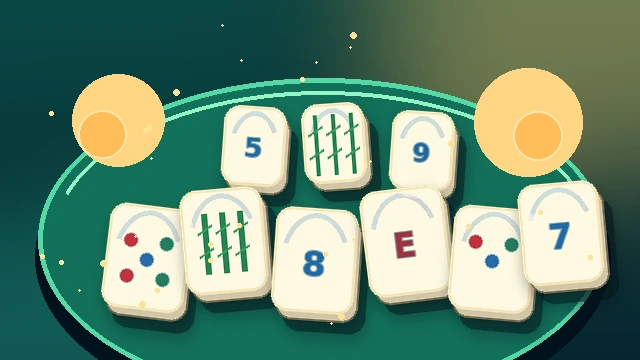
Mahjong solitaire is not the four-player game it borrows its tiles from. There is no drawing, no discarding and no opponent. You remove matching pairs from a stacked layout until the board is empty — and the entire difficulty lives in which pair you remove. Open Mahjong Lounge alongside this guide to try each rule on a real 144-tile board.
The free-tile rule, precisely
A tile can be selected only when both conditions hold:
- No tile rests on top of it. Any overlap from the layer above locks it.
- At least one long horizontal side is open. Left or right — either is enough, but a tile with neighbours on both sides is blocked even when nothing sits above it.
That second condition catches most newcomers. A tile in the middle of a flat row is fully visible, obviously unobstructed from above, and completely unplayable. Visibility is not freedom.
Mahjong Lounge shows this directly: free tiles are brighter and interactive, blocked ones stay visually part of the stack. When a tile looks dim, check the layer above it first, then check whether both its sides are occupied at the same level.
What matches what
Identical tiles match — two Bamboo 5s, two West winds, two Red dragons.
Flowers and seasons are the exception, and they follow the familiar solitaire convention: any flower matches any other flower, and any season matches any other season. They do not have to be identical. This is worth internalising early, because those eight tiles are often the cheapest way out of an awkward position.
Pick the pair that opens the most board
This is the whole strategy in one sentence. Every legal pair is worth the same score; they are not worth the same position.
Before removing a pair, ask what it uncovers:
- Does removing this tile free something on the layer above?
- Does it open the horizontal side of a neighbour?
- Or does it just shorten an already-open edge?
A pair on the outer edge of a flat row usually accomplishes nothing structural. A pair supporting the upper layers can cascade several tiles into play at once. When you have a choice, take the pair that changes the board.
How boards actually dead-end
A layout can become unsolvable while tiles remain. It happens in a specific way, and it is avoidable.
Most tiles exist in sets of four. If three are buried and you remove the fourth’s only available partner early, you can strand the remaining pair under a stack that now has no way to open. The classic version: two identical tiles are both free, you match them, and the other two of that set turn out to be sitting one above the other in the same column — permanently unmatchable.
Two habits prevent nearly all of it:
Check for a third and fourth copy before matching. If you can see all four of a tile and two of them are stacked in the same column, match those two, not the convenient pair on the edge.
Prefer depth over width. Clearing downward opens future options. Clearing sideways across an already-free row spends pairs without buying anything.
Reading a 144-tile layout without being overwhelmed
Thirty layouts at full size looks intimidating. It is more manageable than it appears because you never need to see the whole board at once.
Work in regions. Pick the tallest stack — that is where the constraints are — and clear toward it. Peripheral tiles are usually free for a long time and can wait. The tiles that will strand you are almost always the ones under the peak.
Because layouts are deterministic, a board you failed is a board you can study. The second attempt is not a re-roll; it is the same puzzle with information.
Using hints without leaning on them
Hint highlights a legal pair and never removes it. That distinction matters: it answers “is there a move?” and not “what is the right move?”
Use it when you genuinely believe the board is dead, to confirm whether you are stuck or just not seeing it. Do not use it as a search tool for every pair — the whole skill being trained is spotting free tiles, and outsourcing that trains nothing.
Choosing a mode
Relaxed removes the pressure so you can learn the layouts and practise the free-tile scan. Start here.
Classic is the standard experience once the rules are automatic.
Speed rewards pattern recognition rather than deliberation — worth trying only after free-tile identification is instant for you.
Daily gives everyone the same deterministic board, so a clean solve is directly comparable to someone else’s.
A reasonable progression: learn in Relaxed, move to Classic, then chase no-hint clears on layouts you already know.
Playing without a mouse
Every tile is reachable by keyboard focus, and Enter or Space plays the focused tile. That makes the whole game playable one-handed or without a pointer, which also suits smaller screens where precise tapping on a dense layout is awkward.
Common mistakes
Assuming a visible tile is free. Check above and both sides.
Matching the easy edge pair first. It scores the same and opens nothing.
Forgetting flowers match flowers. Eight tiles’ worth of flexibility, frequently overlooked.
Treating a dead board as bad luck. Layouts are deterministic. A dead board is a sequencing error, and it is repeatable — which means it is learnable.
What to play next
For a different kind of ordering problem where the constraint is lanes instead of layers, try Traffic Tangle. Pin Rescue keeps the think-before-you-act rhythm but adds physics consequences. You can browse all BopBits games for another calm session.