guide
Mahjong Solitaire vs Mahjong Connect: Free Tiles, Linked Tiles and Tile Trays
Mahjong solitaire removes free tiles from a stack; Mahjong Connect links tiles with a path of two turns. See the rules side by side, plus tile-tray games.
Search for a free Mahjong game and you will find three different puzzles that share the same tiles. They ask different things of you. This guide compares them so you can choose the one you actually want. BopBits has the first two: Mahjong Lounge and Mahjong Connect.
At a glance
| Mahjong solitaire | Mahjong Connect | Triple-tile (tile tray) | |
|---|---|---|---|
| Also called | Classic Mahjong, Shanghai solitaire | Onet connect | Tile match, tile tray games |
| Layout | Tiles stacked in layers | One flat grid | Piles of overlapping tiles |
| What you remove | Pairs of identical free tiles | Pairs of identical tiles joined by a path | Groups of three identical tiles |
| What decides a move | Is each tile free? | Is there a route with at most two turns? | Is there room in the tray? |
| Typical pressure | None, a stopwatch or a clock | A countdown | A tray that fills up |
| Where to play at BopBits | Mahjong Lounge | Mahjong Connect | Not offered |
Mahjong solitaire: the free-tile rule
In Mahjong solitaire, tiles sit in a stack. A tile can be picked only when it is free: nothing lies on top of it, and at least one of its long sides, left or right, is open. You remove two matching free tiles at a time. The skill is deciding which pair to remove, because some pairs uncover the next layer and some only trim an edge. A dead end comes from burying the last partner of a set. Mahjong Lounge uses this rule on 144 tiles across 30 layouts; the how-to-play guide covers it in detail.
Mahjong Connect: the path rule
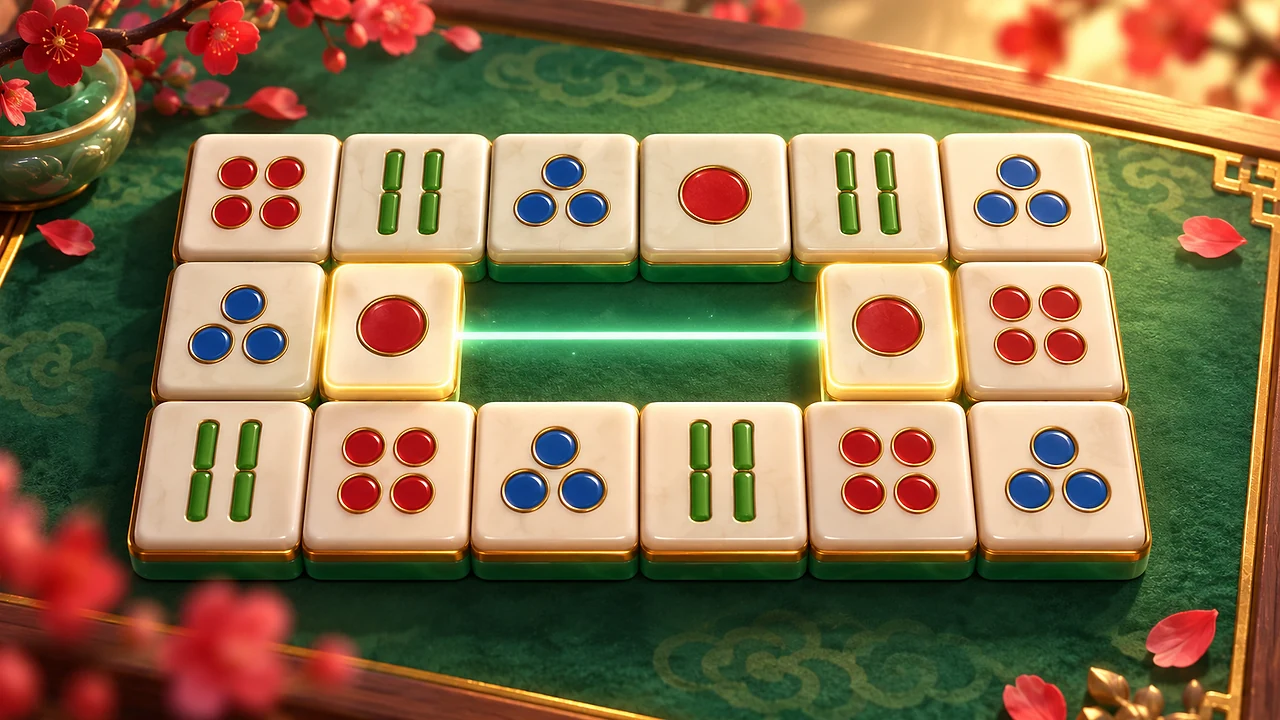
In Mahjong Connect, the tiles lie flat in a grid, and none of them is blocked by another one lying on top. Two identical tiles can be removed when a path with at most two turns through empty cells joins them. The empty border around the board counts as empty space. The decision is about geometry: as you clear tiles, new lines open, and the question is whether a route exists. Mahjong Connect has a clock, a combo score, six levels and a daily puzzle. See how to play Mahjong Connect for worked examples.
Triple-tile games: the tray rule
A third family, often listed as tile match or tile-tray games, works differently. You tap tiles from a pile, they drop into a tray with a small number of slots, and three identical tiles in the tray clear. The pressure comes from the tray filling up, not from a clock or from blocked tiles. BopBits does not publish a game of this kind at the moment, so there is nothing to link to; the point is to know that it is a different puzzle with the same tiles.
The same pair in each game
Take two identical tiles, the 5 of bamboo:
- In Mahjong solitaire they match only if both are free. A 5 of bamboo that sits underneath another tile cannot be chosen, even if it is visible.
- In Mahjong Connect they match when a route of at most two turns through empty cells joins them. A tile can be surrounded on three sides and still link if its fourth side opens onto a route.
- In a triple-tile game you would need a third one, and the tray decides whether you can afford to take them.
Which one should you play?
- You like planning layers, counting how many copies of a tile are still buried and taking your time: Mahjong solitaire. Relaxed mode in Mahjong Lounge has no timer.
- You like quick, visual route-finding with a clock and a score: Mahjong Connect.
- You want a short session: a Mahjong Connect board takes a few minutes, while a full 144-tile Mahjong Lounge layout is more like 8 to 20 minutes.
Both games are free, run in the browser and need no download. If you play one, the other is a short step away: the same tile faces, a different question.