guide
How to Play Parking Escape: Lane Order, Perfect Clears and Stuck Lots
Learn how to read a blocked parking lot, choose the right exit order, earn perfect-clear stars, and recover when every car looks stuck.
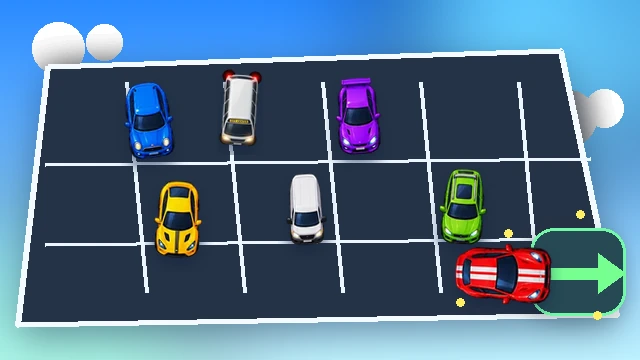
Parking Escape looks like a dexterity game and plays like an ordering problem. Nothing moves until you choose it, no level depends on luck, and a blocked swipe costs you nothing. That combination means every failed lot is a reasoning mistake you can see and fix. Open Parking Escape next to this guide and test each idea on a live board.
The only question that matters on a swipe
New players usually look for the car nearest an exit. That is the wrong question, because proximity is not the rule. A car leaves only when its own lane is completely clear all the way to a board edge.
So the useful question is narrower: which vehicle already has an unobstructed lane to an edge right now? A car one square from the edge with a truck across its path is stuck. A car deep in the lot with an empty column above it can drive straight out.
Scan for that condition before you touch anything. It converts a cluttered lot into a short list of legal moves.
Work from the outside inward
Edge vehicles are the cheapest moves available, and they pay twice. They leave immediately, and their departure opens the exact lanes that inner cars need.
A practical order:
- Clear every car that can already exit without any other move.
- Re-scan. Some inner cars are now legal that were not a moment ago.
- Repeat until the remaining cars need a deliberate unblocking move.
Most of the early districts solve almost entirely on this loop. Later lots break it on purpose, which is when the next section matters.
Blocked swipes are free information, not mistakes
A blocked swipe does not consume a move. That is a deliberate design choice, and it changes how you should play: the lot will tell you why a route fails if you ask it.
Use that. When you cannot see the dependency chain, try the swipe. The rejection identifies the specific blocker. Now you have a concrete sub-goal — free that one vehicle — instead of a vague sense that the lot is stuck.
This is much faster than restarting. Restarting throws away everything you learned; a blocked swipe adds to it.
Solving a lot that looks completely stuck
When no car has a clear lane, one vehicle is holding the whole board. Find it by working backwards:
- Pick any car you want to free. Identify what blocks it.
- Ask what blocks that car.
- Keep going until you reach a vehicle that can already move.
That chain is your move order, in reverse. Lots that feel impossible are usually a chain three or four cars deep, and the entry point is almost always on an edge you dismissed early because that car was not going anywhere useful.
How perfect clears actually work
A perfect clear means solving the lot without blocked attempts and without hints. That is a stricter standard than simply winning, and it rewards a different habit: plan the full order before your first swipe rather than discovering it through feedback.
Two approaches, and they suit different moods:
Exploratory. Swipe freely, use blocked attempts as a map, learn the dependency chain, finish the level. Fast, forgiving, no star.
Planned. Sit with the lot first. Trace the chain visually, confirm every step is legal, then execute. Slower per attempt, but this is the only route to the star.
Because levels are deterministic, a lot you already solved exploratively is an ideal perfect-clear target. You already know the chain — you are just replaying it cleanly.
Using Hint without wasting it
Hint highlights the next legal car. It follows the same rules as the puzzle, so it never skips the ordering problem or invents a move you could not have found.
That makes it a teaching tool rather than a solve button. When it highlights a car you had dismissed, work out why that car is legal now. Nearly always it is because a departure two moves ago opened a lane you did not re-scan. Noticing that pattern is worth more than the single move.
The cost is real, though: a hint forfeits the perfect clear. Use it to break a genuine deadlock, not to save fifteen seconds.
Common mistakes
Chasing the closest car. Distance to the exit is irrelevant. Lane clearance is the only rule.
Not re-scanning after each exit. Every departure changes the legal-move set. Playing from a mental snapshot two moves old is the most common cause of an apparent dead end.
Restarting instead of probing. A blocked swipe is free. A restart is not — it discards the dependency map you were building.
Treating the daily lot as a different game. It uses the same rules and the same determinism. The only difference is that everyone gets the same board, so a clean solution is directly comparable.
A routine that holds up in the later districts
Read the whole lot before the first swipe. List the cars with genuinely clear lanes. Take the ones that unlock the most space behind them, not the ones nearest an exit. Re-scan after every departure. When you stall, work backwards from the car you want to free until you reach something legal, and treat that chain as your move order.
Five districts and eighty levels sounds long, but the rule set never expands. What grows is the depth of the dependency chains, which is exactly the skill this routine trains.
What to play next
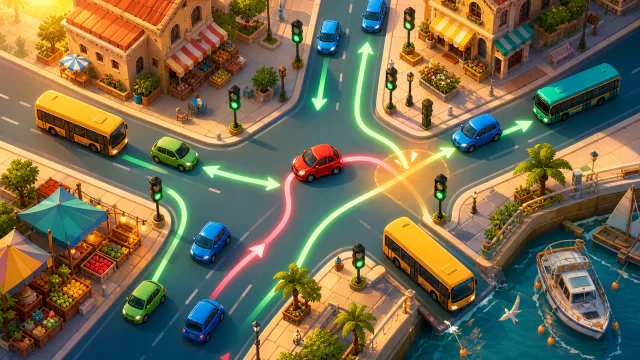
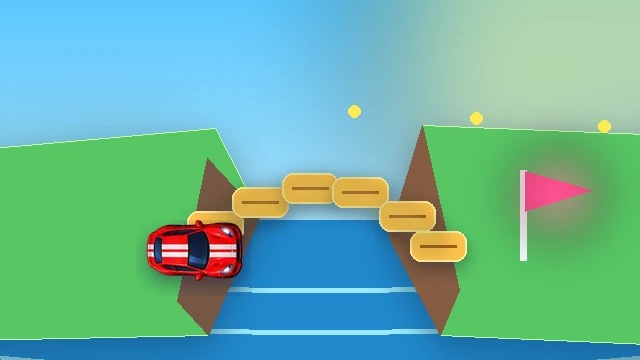
If you want the same traffic theme with time pressure instead of pure ordering, Traffic Tangle adds sliding-car jams and timed junction routing. Bridge Rescue keeps the deliberate-planning feel but swaps lanes for structure. The traffic puzzle games collection lays both mechanics side by side, and you can browse all BopBits games for a different short puzzle.