guide
How to Play Draw Rescue: Ink Budgets, Strong Shapes and Clearance
Learn why short arches beat long roofs, how to anchor a line so it survives impact, and how to spend a limited ink budget in Draw Rescue.
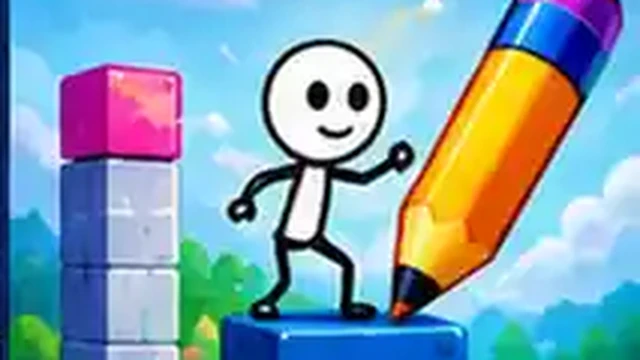
Draw Rescue gives you one line and one simulation. You draw a shelter, release, and physics decides whether the character survives. There is no steering afterwards and no second chance within the round, which makes the drawing itself the entire decision. Open Draw Rescue beside this guide to test each shape.
Ink is a structural budget, not a drawing allowance
The most useful reframe: you are not drawing a picture with a length limit. You are spending a fixed amount of material on a structure, and structures fail in predictable ways.
That changes what “using all the ink” means. A long, thin barrier that consumes the whole budget is usually worse than a short one that leaves ink unspent, because length buys coverage while shape buys strength. Coverage does not help if the shape folds.
Ask what the ink is doing, not how much of it you used.
Short arches beat long flat roofs
A flat horizontal line is the weakest useful shape in the game. Load applies perpendicular to it along its whole span, and the middle — furthest from any support — takes the worst of it.
An arch redirects force outward toward its contact points instead of concentrating it at the centre. It is stronger with less material, which is exactly the trade the ink budget rewards.
If your instinct is to draw a roof, draw a smaller dome instead. You will usually have ink left over and a shelter that holds.
Anchor against something stable
A line floating in open space has to absorb everything itself. A line that terminates against solid ground or an existing surface transfers force into that surface.
Two practical rules:
- End both ends on something solid. A shape anchored at one end pivots around it.
- Meet the surface at a steep angle, not a shallow one. A shallow contact slides; a steep one braces.
When a shelter fails and you cannot see why, check the contact points before you redesign the shape. It is more often the anchoring than the geometry.
Leave clearance — surviving the hit is not the same as protecting
This is the failure that feels most unfair, and it is the most instructive. Your barrier holds. The character still dies.
What happened: the shelter was drawn too tightly. Either it deformed just enough under impact to touch the character, or it deflected a hazard into the protected space instead of away from it. The structure did its job and the geometry did not.
Build in a gap. A dome with breathing room under it survives outcomes that a skin-tight shell does not, because it tolerates a little deformation and gives deflected hazards somewhere to go that is not the character.
Think about where hazards go, not just where they come from
A barrier is a redirector. Anything you stop has to end up somewhere.
Before releasing, trace the likely path after contact. A steep surface angled toward the character will faithfully deliver a hazard into the thing you were protecting. Angling the same surface the other way costs no extra ink and sends the hazard clear.
This is why compact solutions usually work: less surface area means fewer opportunities to accidentally aim something at the wrong place.
Reading a failure
The simulation is the feedback. Watch it rather than restarting immediately, and identify which of four things happened:
The line broke or bent. Shape or ink distribution problem — try an arch, or shorten the span.
The line slid. Anchoring problem — steepen the contact angle or find a more stable surface.
The line held but a hazard reached the character anyway. Clearance problem — same shape, more room.
A hazard was deflected into the character. Aiming problem — change the surface angle, not the strength.
Those four have different fixes. Redrawing the same shape slightly bigger addresses only one of them, which is why it so often fails twice.
Common mistakes
Spending the whole ink budget by default. Unused ink is not wasted; over-long lines are.
Drawing flat. Curves are stronger per unit of ink than straight spans.
Sealing too tightly. A shelter needs room to flex without touching what it protects.
Ignoring the anchor. The strongest shape in the game fails if it is standing on nothing.
Restarting before watching. The simulation tells you which of the four failure modes you hit. That information is the whole game.
What to play next
Pin Rescue keeps the rescue theme but swaps drawing for order-of-operations reasoning about gravity. Ricochet Rescue turns the same prediction instinct into bank-shot geometry. Browse all BopBits games for another short physics puzzle.