guide
Block Bits Wood Block Puzzle Strategy and Daily Guide
Improve at Block Bits by reading all three tray pieces, preserving open space, building intersection clears and keeping Daily Workshop attempts comparable.
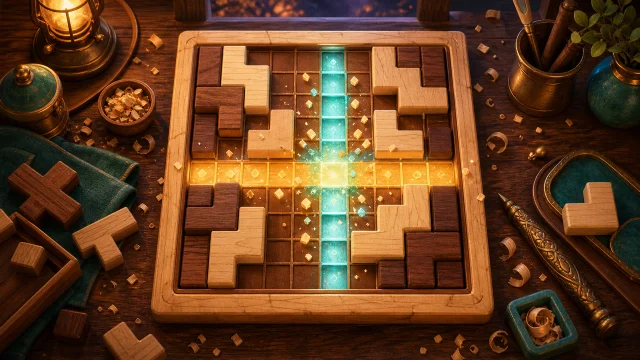
Block Bits: Wood Workshop is an eight-by-eight wood block puzzle with no falling timer. The tray shows three carved pieces at once, and all three must be placed before the next tray appears. That makes space planning more important than reacting quickly. Open Block Bits beside this guide if you want to test the board-reading routine in Endless, Daily Workshop, or one of the fixed Challenges.
Read the whole tray before placing one piece
The first legal placement is not always the useful placement. Compare the width, height, and shape of all three pieces before moving any of them. Identify the piece with the fewest comfortable homes; that constrained piece usually deserves attention before a small shape that can fit almost anywhere.
Also look for conflicts. If the largest piece and an awkward corner both need the same open zone, placing either one carelessly may strand the other. A good opening preserves at least one valid region for every piece currently visible.
Preserve broad space instead of isolated holes
A single empty cell looks harmless, but narrow pockets reduce the number of future shapes the board can accept. Try to keep one broad rectangular area open rather than scattering several tiny gaps around completed-looking clusters.
Edges are useful when a piece matches them cleanly. They become dangerous when irregular placements build a jagged wall that cannot accept wider pieces. Before filling an edge gap, check whether the placement keeps the remaining open area connected.
Build intersection clears deliberately
Completing a row and a column with one placement clears both and advances intersection Grain Goals. The most reliable setup is to bring a row and column close to completion while preserving their shared cell or shared placement zone. Do not force the intersection if doing so leaves the other two tray pieces without a home.
Treat Grain Goals as an extra objective, not a different rule set. Legal placement and base score do not change. A useful goal opportunity fits the board plan you already have; a poor one asks you to damage future space for a short-term marker.
Use the Daily Workshop as a comparison
Daily Workshop gives every player the same UTC piece sequence. Your first unmodified result remains the comparable attempt, while later runs are labeled practice. That means the daily is most useful when you play the first attempt carefully and use practice to test one alternative decision.
After a board closes, remember the first placement that created an awkward pocket or consumed the only home for a later piece. Change that decision in practice instead of trying to memorize the entire sequence.
Approach Challenges as proof boards
The 30 Challenges use fixed trays, move caps, solution hashes, instant restart, hints, and one local undo. A hint follows the verified solution path, but it is more useful when you ask why that move preserves the remaining placements. The undo restores the exact state before the previous move, so use it to compare two candidate placements without replaying the full board.
Apprentice boards teach space preservation with shorter sequences. Joiner and Master boards make tray order and intersection setup more demanding. In every tier, the same rule applies: confirm homes for all three visible pieces before optimizing score or Grain Goals.
A simple board-check routine
- Find the tray piece with the fewest valid regions.
- Check whether two pieces compete for the same region.
- Preserve one broad connected area for the next tray.
- Prefer a row-and-column intersection only when all three current pieces still fit.
- After a failure, revise the earliest placement that created the unusable pocket.
This keeps the puzzle deliberate without turning each move into a long calculation.
What to play next
If you like planning space but prefer moving existing pieces, Traffic Tangle uses sliding cars and route order. Bit Bolt Lab turns temporary space into a sorting problem, while the puzzle games hub collects the broader BopBits puzzle catalog. You can also browse all BopBits games for a different short session.