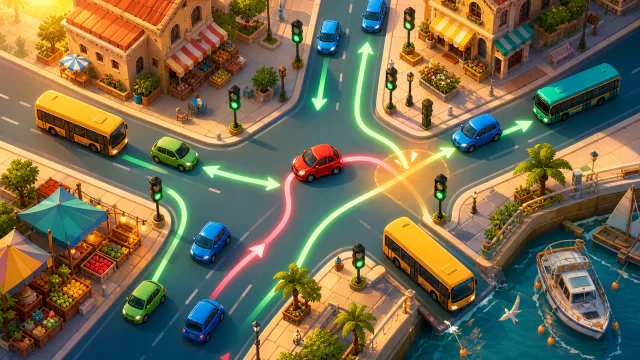
behind the game
Behind the Game: How Highway Rush Makes Traffic Fair
The design rules inside Highway Rush: a 450 ms telegraph floor, score-only Flowline tiers, deterministic simulation and comfort controls.

Endless driving games have a trust problem. When a run ends, the player silently asks: was that my mistake, or did the game spawn a wall? Highway Rush: Flowline is built around a small set of rules that make the answer provable — and they are worth writing down, because the same rules shape every BopBits game.
Rule 1: nothing moves without warning
Every vehicle that is about to change lanes shows an amber telegraph for at least 450 milliseconds before it moves. That number is a floor, not an average. The consequence is subtle but important: a gap is not “open” just because it is empty — it is open only if the cars beside it are not announcing a move into it. Crashes stop being random the moment the player learns to read the warning as part of the obstacle.
The same floor appears across the catalog — Bop Dash telegraphs runner obstacles at 920 milliseconds, comfortably above it — because a fairness rule you apply once is a gimmick, and one you apply everywhere is a promise.
Rule 2: score systems must not touch the simulation
Highway Rush’s signature system, Flowline, braids a visible trail when you make clean near misses on alternating sides. Every three alternating segments raise the tier, and higher tiers increase the points of later close passes.
What tiers never change: speed, steering, collision size, or traffic behavior. Flowline is deliberately score-only. The moment a combo system alters the physical game, players can no longer tell whether a crash came from their line or from their reward — so the reward stays in the scoreboard and out of the simulation.
The revive follows the same discipline. One optional revive exists per run, offered only after a crash, and it clears traffic before the simulation resumes — it never rewinds or edits a live situation.
Rule 3: the run must be explainable afterwards
After each run, the report shows score, distance, peak Flowline tier and the closest clean pass. That last number matters: it turns “I think I was skimming traffic well” into a measurement. The Share Run Card renders those results into a portrait image locally — no account, no upload of save data.
Missions follow the same principle at a larger scale. Sixty fixed missions with checkpoints give a run a defined result, and route events — city work zones, canyon rain, emergency corridors — change the visual reading problem without changing the fairness rule underneath. Even Endless mode’s four biome gates (Coast, City Works, Canyon Storm, Neon Night) alter scenery, never handling.
Rule 4: comfort settings are not difficulty settings
Pause clears held steering input and freezes fixed-step simulation time; leaving the tab pauses the same way, and returning never silently advances traffic. Reduced Motion removes camera shake and shortens the Flowline trail. Safe Flashes, on by default, keeps collision and weather effects away from rapid full-screen flashing.
None of these change score or difficulty. That separation is deliberate: a player should never have to choose between a comfortable presentation and a fair scoreboard.
Why this matters beyond one game
These four rules — telegraph floors, score-only rewards, explainable results, comfort without difficulty trade-offs — are the shared contract behind BopBits games. Traffic Tangle freezes and highlights both routes on a collision so the failure is legible; Bop Dash makes rhythm a bonus that cannot kill you. Different mechanics, same promise: when a run ends, you know why.
You can test the rules yourself — Highway Rush plays in the browser with no download, and the amber telegraphs are visible from the first mission.