guide
How to Play Bop Dash: Beat Streaks Without the Rhythm-Game Stress
Learn the Bop Dash three-lane runner controls, the 90 ms beat window, dash charge economy and how to clear all 45 missions across the night city.
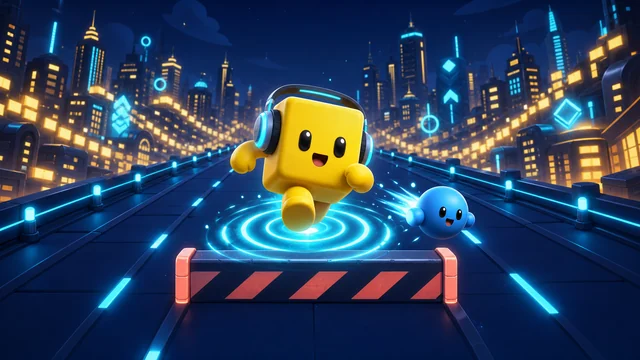
Bop Dash is a one-thumb endless runner where music is a bonus system, not a punishment system. You swipe between three lanes, hop over barriers, slide under low signs, and dash through marked crates — and if an action lands within 90 milliseconds of the beat, it feeds a streak that lights up the night city. Miss the beat and the exact same move still happens safely. You can play Bop Dash in the browser while reading; runs restart instantly and progress saves locally.
Learn the moves before the music
The full input set is small: swipe left or right to change lanes, swipe up to hop, swipe down to slide, and tap the Dash button to spend a charge. On a keyboard, arrows and Space cover the same actions.
Spend your first run ignoring the beat entirely. Every obstacle appears at least 920 milliseconds before impact, and only one blocking obstacle is introduced at a time, so the survival game is honest: read the silhouette, pick the response, execute. Rhythm layered on top of shaky lane-reading collapses; rhythm layered on top of calm lane-reading is easy.
The 90 ms window is a bonus, never a trap
The design rule worth internalizing: an off-beat move is mechanically identical to an on-beat move. Timing with the pulse adds score and streak; missing it cannot cause a crash. This means you should never delay a survival action to catch the beat. Dodge first — the pulse will come around again.
Once survival feels automatic, start nudging inputs toward the pulse. Because obstacles telegraph early, you usually have room to act a beat earlier or later than your reflex suggests. That slack is where the streak is built: choose which beat you act on instead of reacting on none.
Manage dash like a resource, not a panic button
Dash charges refill from cyan sparks, and sparks are deliberately placed away from immediate threats — collecting one is a choice, not a forced detour. Two habits pay off:
- Dash into breakable crates on purpose. A crate you break with a charged dash is a lane you did not have to leave.
- Do not hoard past full. If your dash is charged and a crate lane also holds sparks, dashing through converts a blocked lane into a refill.
Panic-dashing at an unmarked obstacle wastes the charge; hopping or sliding was free.
The 45-mission route through the city
Missions come in three arcs of fifteen: warm rooftops first, then a neon market, then the skyline rail. Goals mix distance, safe beat hits, and collected sparks — so a mission asking for beat hits is the right moment to practice pulse timing, and a distance mission is the right moment to play purely safe.
Progress, best score, best distance and mission position all save in your browser. A refresh does not erase the campaign, so short sessions add up.
A three-run practice loop
- Run one: no rhythm. React to silhouettes only, and notice how early each obstacle announces itself.
- Run two: pick one action type — lane changes only — and try to land those on the pulse while everything else stays reflexive.
- Run three: add hops and slides to the pulse, and route through one spark cluster to keep dash charged.
Because off-beat play is safe, this progression never costs you a run; it only changes how much of the city lights up.
What to play next
If you want lane-reading with a steering wheel instead of a beat, Highway Rush applies the same telegraphed-obstacle fairness to endless highway driving. If you like runners that make you think mid-lane, Bit Merge Rush replaces hazards with arithmetic gates. More of the genre lives on the endless runner games page. Or browse all BopBits games to compare session lengths.