guide
How to Play Bit Merge: Drop Placement, Chains and the Danger Line
Learn where to drop orbs, how to use the next-orb preview, why big tiers belong low, and how to survive a crowded reactor in the Bit Merge physics puzzle.
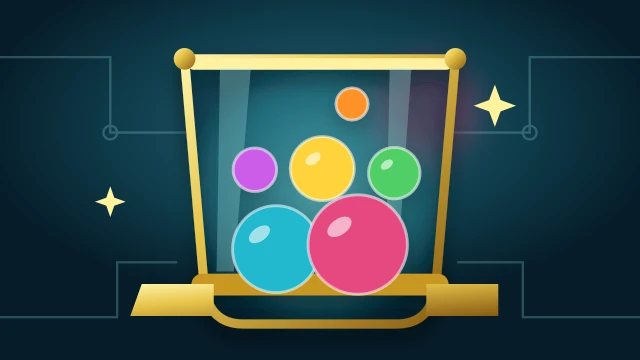
Bit Merge is the physics merge puzzle: you drop jewel orbs into a brass-and-glass reactor, equal tiers combine into the next tier up, and the run ends when the stack reaches the danger line. It is a game about placement under gravity.
If you were looking for the runner where you steer through arithmetic gates, that is a different BopBits game — see Bit Merge Rush. This guide is about the reactor. Open Bit Merge beside it to follow along.
The reactor punishes scattering
Two orbs merge when equal tiers touch. That sounds forgiving until you notice the corollary: an orb that has no partner nearby is occupying space indefinitely.
Scattering low tiers across the width of the reactor is the most common way runs end early. Each one is individually harmless and collectively fatal — you fill the reactor with singles that can never resolve because their partners are three orbs away behind larger tiers.
Drop matching low tiers close together. Give them room and proximity to find each other. A tight cluster of small orbs will collapse into one larger orb; a spread-out row of the same orbs will not.
Big tiers belong at the bottom
Large orbs are heavy, physically awkward and nearly impossible to reposition once placed. Anything that lands on top of one is stuck above it.
Treat the reactor as layered:
- Bottom: the large tiers you have already built. They are stable and out of the way.
- Middle: working space for mid-tier merges.
- Top: where new orbs arrive, and where the danger line is.
A large orb dropped high does two kinds of damage — it consumes room near the danger line, and it buries whatever it lands on. When a big merge is about to happen, think about where the result will sit, not just that it will happen.
The next-orb preview is the actual decision point
The preview is not decoration. It tells you what is coming, and the current drop should be chosen with the next one in mind.
The useful pattern: if the preview matches something already on the board, place the current orb so it does not block the lane to that match. If the preview matches the current orb, you have a free pair — drop them adjacent and take the merge immediately.
Playing one orb at a time without reading the preview is playing at half the available information. Most of the difference between a short run and a long one is here.
Aim with the drag, and use the walls
You aim by dragging left or right across the reactor and releasing. That means you have precise horizontal control and no control at all after release — everything afterwards is gravity and collision.
Two consequences worth using:
The walls are surfaces you can play against. An orb dropped tight to a wall settles predictably. An orb dropped in open middle space can roll somewhere you did not intend.
Aim for the gap, not the target. Orbs settle into low points. Dropping directly above a partner often means landing on it rather than beside it, and merges need contact at rest, not a bounce.
When the reactor gets crowded
Late in a run the danger line is close and the board is dense. This is where runs are usually lost to panic drops.
Slow down. Look for the largest available merge, not the nearest one — a mid-tier merge frees more space than a bottom-tier one because it removes a bigger object. Then check whether that merge cascades: a resolved pair often drops the stack and puts two more equal tiers in contact.
A single well-chosen drop can chain several merges and reclaim a third of the reactor. A hurried drop into the nearest gap almost never does.
The daily run is a repeatable puzzle
The daily-core run uses a deterministic preview sequence. Everyone gets the same orbs in the same order, and so do you if you play it again.
That turns it from a high-score chase into something closer to a puzzle. You already know what is coming — the second attempt is about placing the same sequence better, not hoping for a friendlier roll. If you want to actually improve at the game rather than just play it, this is the mode to repeat.
Common mistakes
Spreading low tiers. Singles with distant partners are dead space.
Building large tiers high. They cannot be moved and they crowd the danger line.
Ignoring the preview. Half the information in the game, free, on screen.
Dropping directly onto a match. Merges need contact at rest. Aim beside, not on top.
Speeding up when the reactor fills. That is precisely when the largest available merge is worth finding.
What to play next
Block Bits keeps the stacking pressure with placement instead of physics. Bit Bolt Lab is another compact puzzle from the same family. If you want the arithmetic runner rather than the reactor, Bit Merge Rush is the one you are thinking of. Browse all BopBits games for something different.