guide
How to Play Bit Merge Rush: Gate Order, Multipliers and the Boss Check
Learn when to take a multiplier instead of an addition, why obstacles cost more than they look, and how to read the boss health bar in Bit Merge Rush.
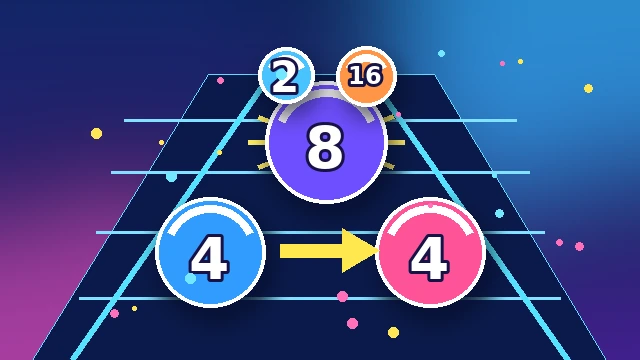
Bit Merge Rush is the arithmetic runner: you steer horizontally, pass through gates that add, multiply, subtract or divide your Bit, and arrive at a boss whose health you either beat or do not. It is a game about operation order under time pressure.
If you were looking for the physics puzzle where orbs drop into a reactor and equal tiers combine, that is Bit Merge — a different game with a similar name. This guide is about the runner. Open Bit Merge Rush beside it.
The gates mean exactly what they say
The symbol on each gate is the arithmetic the engine applies. There is no hidden modifier, no scaling and no randomness. Cyan and green add or multiply; pink and red subtract or divide.
That consistency is the foundation of every decision below. You are not guessing at the gate — you are doing arithmetic at speed. The colour families stay the same across every world, so after a few runs you can classify a gate before you can read its number.
Multipliers late, additions early
This is the single most valuable habit, and it follows directly from how multiplication works.
A ×3 gate applied to a Bit of 4 gives you 12. The same gate applied to a Bit of 40 gives you 120. The multiplier did not change; what it acted on did.
So the run has a natural shape:
- Early: take additions. Build a base worth multiplying.
- Later: take multipliers. Now they are operating on a real number.
A ×5 in the opening seconds is often worth less than a +20, and a +20 near the finish is almost always worth less than a ×2. When two gates are both reachable, the answer depends on where you are in the stage, not on which number looks bigger.
Obstacles cost more than the gate gains
An obstacle shaves value off your Bit. The instinct is to weigh that loss against the gate behind it and take the trade if the gate looks good.
Usually you should not. Two reasons:
The loss compounds backwards. A hit early in the stage reduces the base that every later multiplier acts on. The visible cost is the shaved value; the real cost is that number multiplied by everything downstream.
A smaller safe gain beats a larger risky one. Taking a +8 in a clear lane and keeping your value intact routinely finishes ahead of taking a ×2 through an obstacle.
When both nearby gates look good and one is guarded, take the other one. The clean lane is the correct default.
Read the boss health bar during the run, not at the end
The boss health is visible throughout the stage. That makes it a target, not a surprise — and it changes how you should play the second half.
Compare your current Bit against it as you go:
Comfortably ahead? Stop taking risks. Prioritise clean lanes over marginal gains. You have already won; the only way to lose is to get greedy near an obstacle.
Behind? Now a risky multiplier is justified. A safe route that arrives short is a loss with extra steps, so take the gate that closes the gap even if the lane is guarded.
Most losses come from playing the whole stage the same way regardless of the bar. The bar is telling you which mode you should be in.
Steering: drag or keyboard
Drag horizontally to line the Bit up with a gate or an open lane, or use A and D or the arrow keys.
Keyboard tends to be more precise for threading between an obstacle and a gate, because it moves in discrete steps rather than tracking a finger. Dragging is faster for wide repositioning across several lanes. Sixty stages is enough for either to become comfortable, and the game supports both portrait and landscape, so the choice can follow the device.
Deterministic stages reward replaying
Stages are deterministic. The same stage produces the same gates in the same lanes every time.
That means a failed stage is not bad luck and a replay is not a re-roll — it is the same problem with information you did not have the first time. If you narrowly missed the boss, you can work out exactly which gate choice to change, rather than hoping for a friendlier layout.
Cosmetic progression is separate from the score calculation, so nothing you unlock changes the arithmetic. Improvement comes from lane reading only.
Common mistakes
Taking the biggest number. A multiplier’s value depends entirely on the Bit it acts on. Position in the stage matters more than the digit on the gate.
Trading a hit for a gate. The hit reduces everything downstream, not just the current value.
Ignoring the boss bar until the end. It tells you whether to play safe or push, and that decision is only useful while there are still gates left.
Assuming a symbol is decorative. The displayed arithmetic is exactly what runs.
What to play next
Highway Rush keeps the lane-reading skill and drops the arithmetic. Idle Factory turns compounding into a slower resource loop. For the reactor puzzle with the similar name, see Bit Merge. Browse all BopBits games for another quick run.